 English
 فارسی
فارسی




SomaBTC MT5: Multi-Strategy Bitcoin Breakout Expert Advisor
What Is SomaBTC MT5?
SomaBTC MT5 is a multi-strategy breakout Expert Advisor developed exclusively for Bitcoin trading through the BTCUSD instrument on MetaTrader 5. It combines 18 independently configured trading strategies in a single EA running on one chart, providing a portfolio-based approach to automated Bitcoin trading.
Rather than relying on one breakout setup that may be suited to only a narrow set of market conditions, SomaBTC MT5 brings together multiple strategy configurations across different timeframes, breakout widths, and optimization ranges. All 18 strategies operate through a shared execution engine while retaining their own magic numbers, trade comments, swing-detection settings, exit rules, news-protection windows, and lot-sizing allocations.
This design allows traders to manage multiple Bitcoin breakout strategies without attaching numerous Expert Advisors to separate charts.
SomaBTC MT5 also includes configurable portfolio risk settings, fixed and automatic position sizing, margin call protection, US economic news filters, daily and weekly trading-hour controls, optional prop firm compliance features, and a live on-chart dashboard.
These features provide flexibility for portfolio configuration and monitoring. Actual trading performance depends on market conditions, strategy selection, position sizing, broker execution, and account-specific trading costs.
Key Features of SomaBTC MT5
SomaBTC MT5 combines multiple breakout configurations with account-level risk and monitoring tools.
- 18 independent trading strategies: Run a multi-strategy Bitcoin portfolio through one Expert Advisor.
- Five internal timeframes: D1, H12, H8, H4, and H1.
- Three breakout-width variants: Broad, Medium, and Narrow.
- Four optimization ranges: Complementary in-sample and out-of-sample periods, plus wider historical training and recent-period validation.
- Two optimization objectives: Return relative to balance drawdown and return relative to equity drawdown.
- Automated and fixed lot sizing: Select position sizing based on account capital or a fixed trade volume.
- RiskMultiplier and MaxLots: Adjust calculated exposure and optionally limit EA-level lot size.
- MarginCallProtection: Help manage potential margin requirements from simultaneous same-direction pending orders.
- US economic news filters: Configure protection around NFP, CPI, and IR/FOMC events.
- Daily session controls: Optionally close trades at the end of the US session and resume trading at the start of the Asian session.
- Weekly trading schedule: Configure Monday opening and Friday closing times, with weekend trading optional.
- Optional prop firm controls: Configure daily drawdown thresholds, hedging restrictions, pending-order limits, and entry/exit randomization.
- Live trading dashboard: Monitor positions, account drawdown, trading costs, spread, and active strategies.
- Flexible currency references: Support USD, EUR, GBP, HKD, SGD, or a custom currency conversion pair for position sizing.
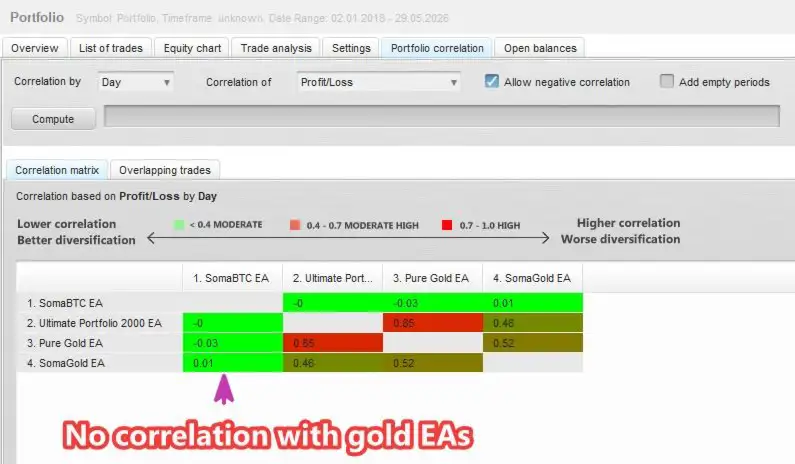
SomaBTC MT5 is designed for traders who want to evaluate a structured portfolio of Bitcoin breakout strategies rather than manage a single entry model. However, using multiple strategies does not eliminate market risk or guarantee diversification during periods of high volatility.
How the 18-Strategy Bitcoin Trading Portfolio Works
Bitcoin markets can move through a wide range of volatility conditions, from prolonged directional trends to rapid reversals and periods of consolidation. A breakout strategy that performs differently in one market regime may behave differently when volatility, liquidity, and price structure change.
SomaBTC MT5 combines strategies built around different internal timeframes, breakout widths, and historical optimization ranges. The objective is to diversify the portfolio’s entry logic and reduce dependence on a single trading configuration.
Five Internal Timeframes
The portfolio uses five internal timeframe groups:
- D1: Daily timeframe
- H12: 12-hour timeframe
- H8: 8-hour timeframe
- H4: 4-hour timeframe
- H1: 1-hour timeframe
The EA reads these timeframes internally. As a result, the chart timeframe selected when attaching SomaBTC MT5 does not determine the operating timeframe of every strategy.
This allows strategies with different holding horizons and breakout configurations to operate within one BTCUSD trading system.
Three Breakout-Width Variants
The portfolio contains three breakout variants designed around different swing-detection ranges.
V1 — Broad
Broad strategies use wider swing ranges to identify larger breakout structures. These configurations are designed to capture a different set of price conditions than tighter breakout models.
V2 — Medium
Medium strategies use intermediate swing ranges, offering a middle-ground configuration for breakout detection and potential setup frequency.
V3 — Narrow
Narrow strategies use tighter swing ranges to identify more localized breakout conditions. Their tighter settings can also make them more sensitive to short-term price fluctuations.
Combining these three variants with five internal timeframes gives the portfolio multiple ways to identify potential Bitcoin breakout opportunities.
Nevertheless, different configurations can still react similarly to a major BTCUSD price movement. Portfolio diversification does not guarantee independent returns or prevent simultaneous losses.
Portfolio Creation and Historical Strategy Validation
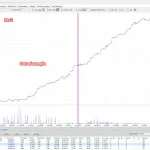
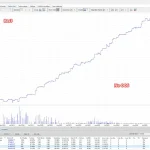
According to the supplied product documentation, SomaBTC MT5 was developed through 120 separate optimization configurations. The research combined four historical optimization ranges, five internal timeframes, three breakout-width variants, and two return-to-drawdown objectives.
The resulting strategy pool was then filtered to identify the 18 configurations included in the final portfolio.
120 Optimization Configurations
The documented research framework combined the following elements:
- Four optimization ranges: Res1, Res2, Res3, and Res4.
- Five timeframe groups: D1, H12, H8, H4, and H1.
- Three breakout variants: Broad, Medium, and Narrow.
- Two optimization objectives: Return / Balance DD and Return / Equity DD.
The number of candidate configurations was calculated as:
4 × 5 × 3 × 2 = 120 optimization configurations.
This framework was intended to explore different combinations of timeframe, breakout breadth, and historical optimization periods instead of selecting strategies from a single uniform configuration.
Four Historical Optimization Ranges
The supplied product specifications identify the following periods:
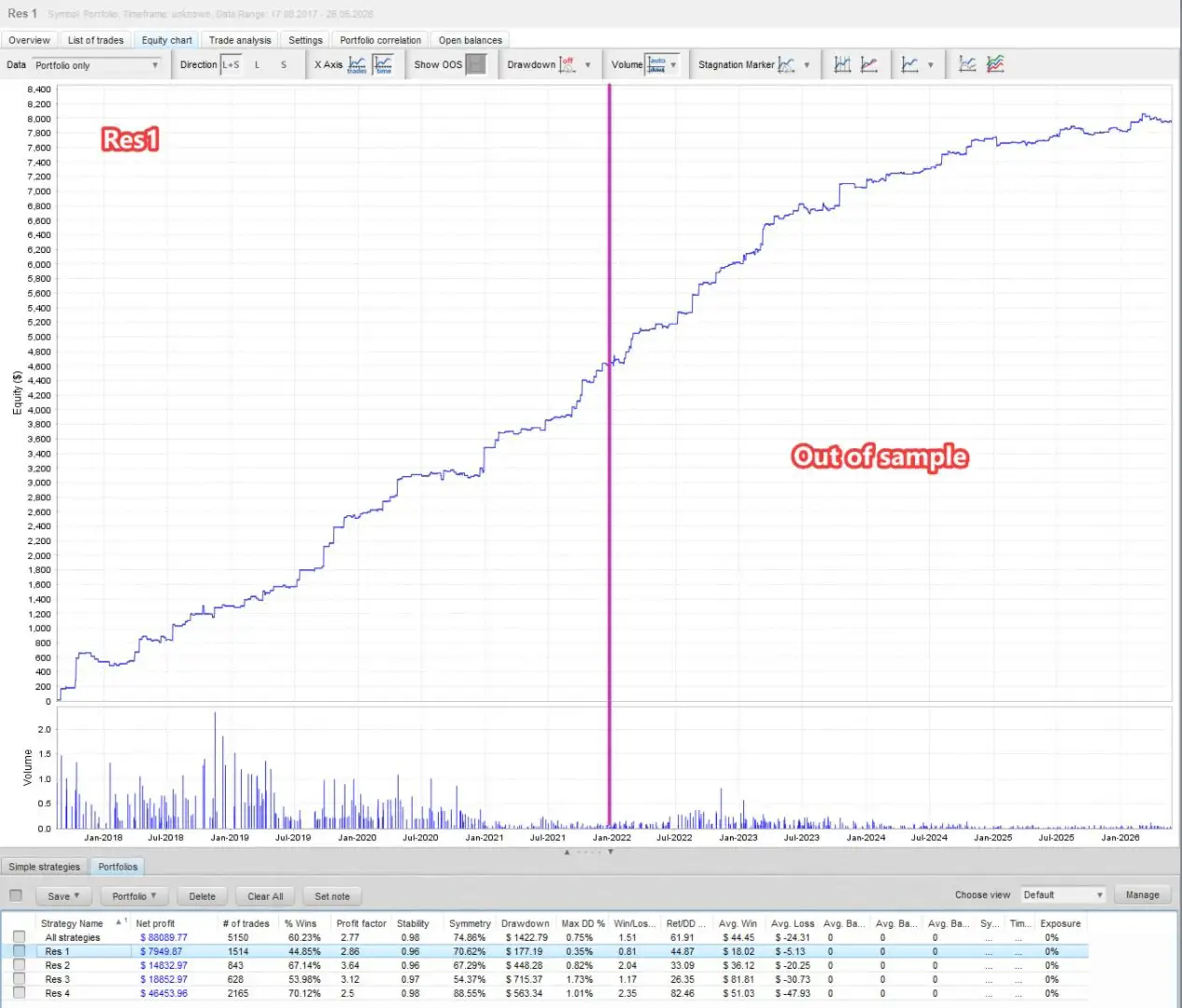
Res1 — Complementary historical range
- In-sample period: August 14, 2017 – January 1, 2022
- Out-of-sample period: January 1, 2022 – May 30, 2026
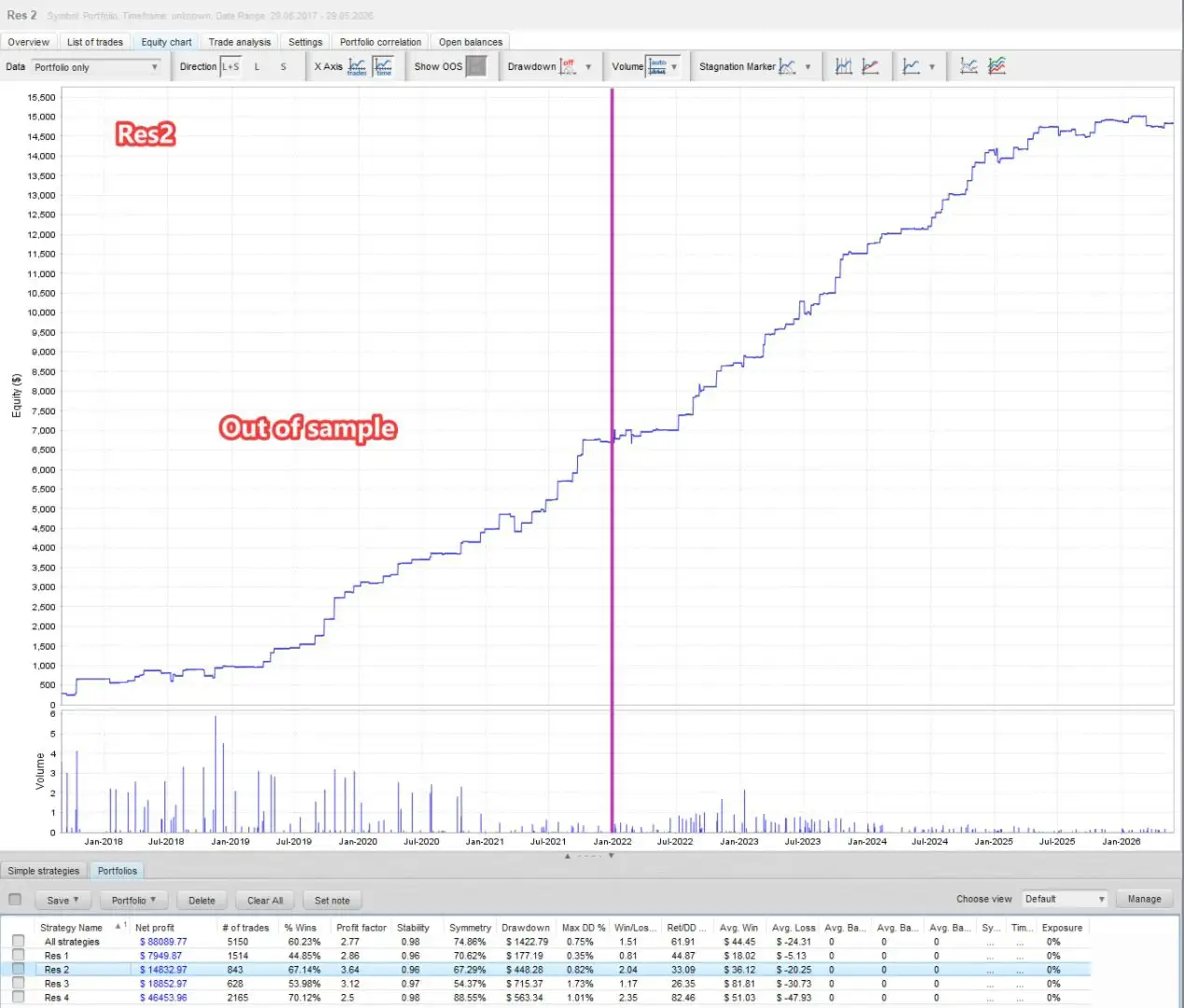
Res2 — Reverse out-of-sample range
- In-sample period: January 1, 2022 – May 17, 2026
- Out-of-sample period: August 14, 2017 – January 1, 2022
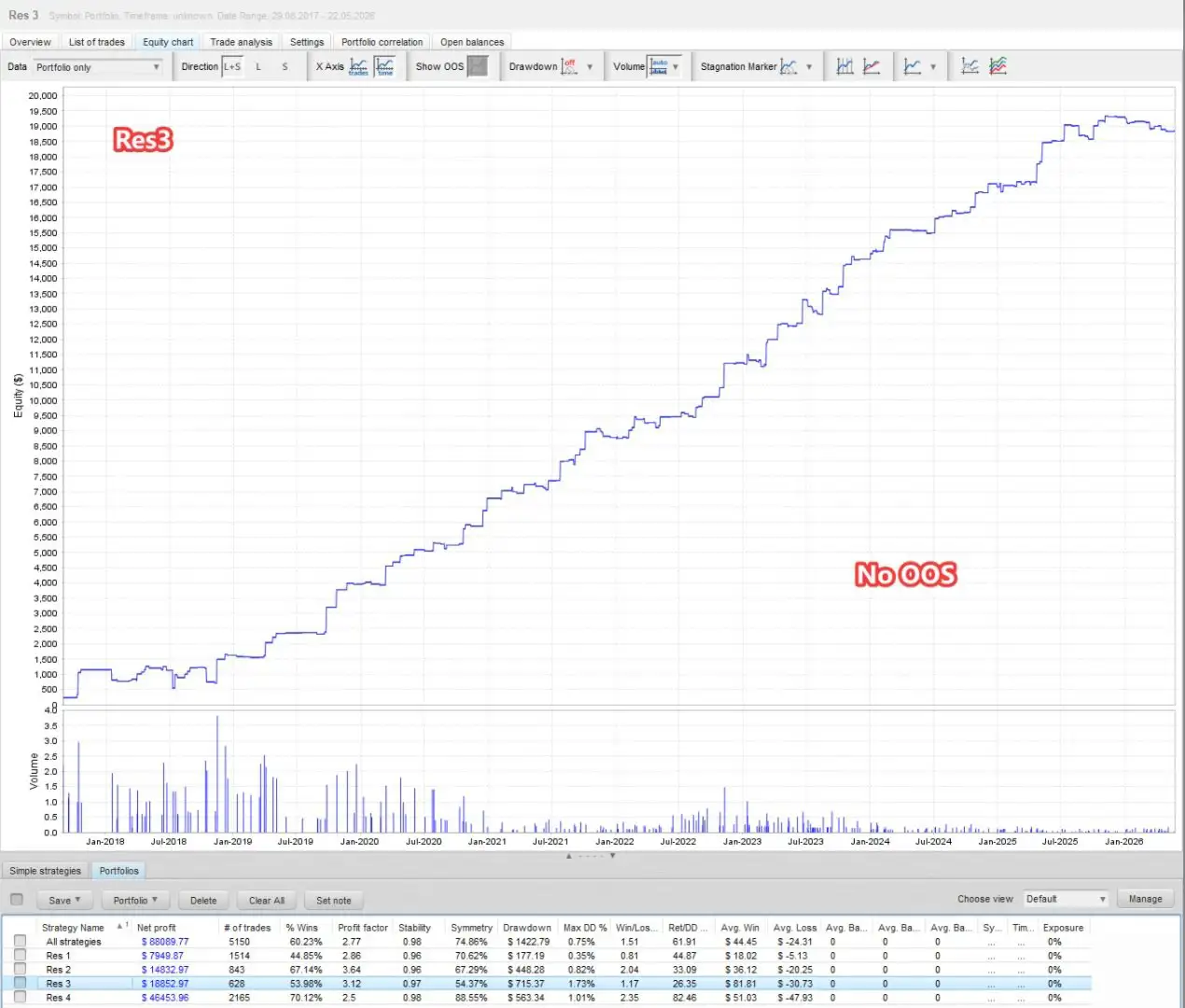
Res3 — Full-range training
- In-sample period: August 14, 2017 – May 17, 2026
- Out-of-sample period: None; the full specified range was used for training.
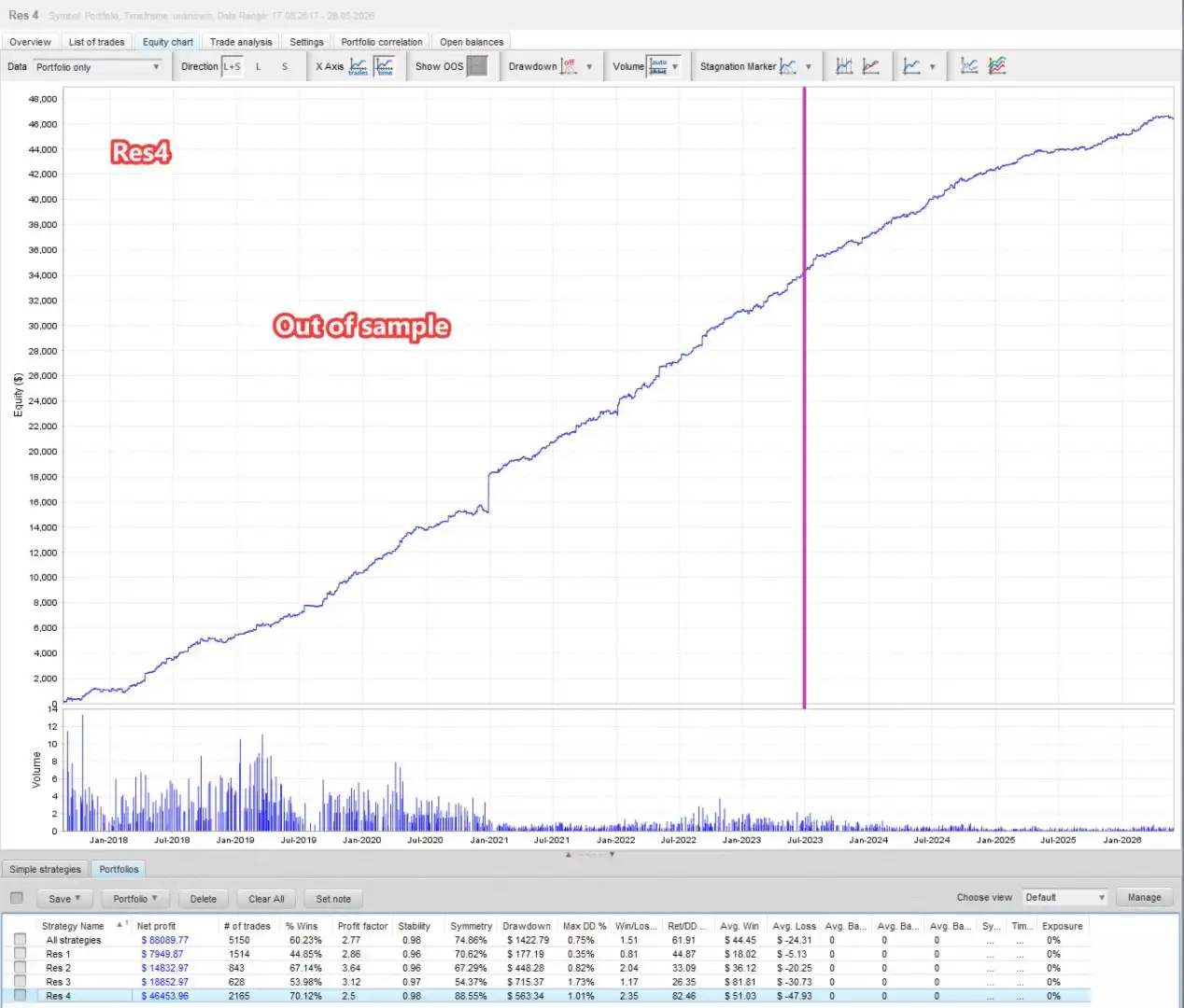
Res4 — Recent-market validation
- In-sample period: July 3, 2023 – May 30, 2026
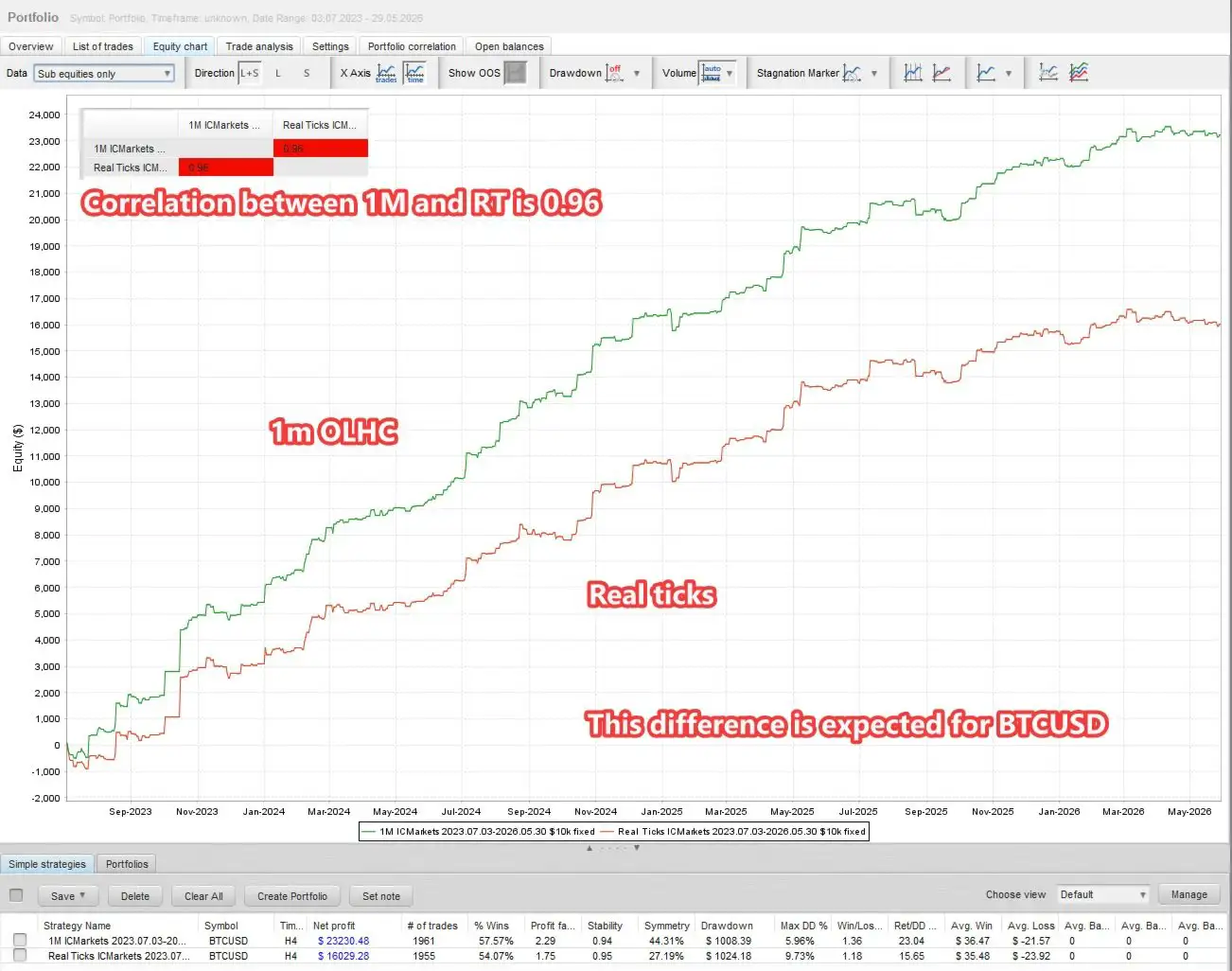
- Validation approach: Comparison of 1M OHLC and Real Ticks testing quality.
Res1 and Res2 use complementary historical periods so that each range can be evaluated against the other’s corresponding out-of-sample period. Res3 adds a wider training window, while Res4 focuses on a more recent period of cryptocurrency market behavior.
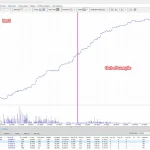
These methods are intended to examine strategy behavior across different historical conditions. However, an optimization framework alone does not establish that a strategy will remain profitable in future markets.
Return-to-Drawdown Optimization
The candidate configurations were evaluated using two optimization objectives:
- Return / Balance DD: Assesses return relative to balance drawdown.
- Return / Equity DD: Assesses return relative to equity drawdown, which can include unrealized losses on open positions.
Using both objectives allows the research process to consider different aspects of account performance rather than evaluating returns in isolation.
Balance and equity drawdown can differ significantly when trades remain open during adverse price movements. Equity-based analysis is therefore relevant when assessing the combined exposure of a multi-strategy Bitcoin trading portfolio.
Real-Tick Testing and Strategy Filtering
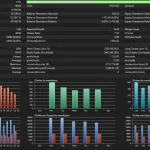
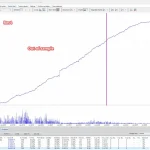
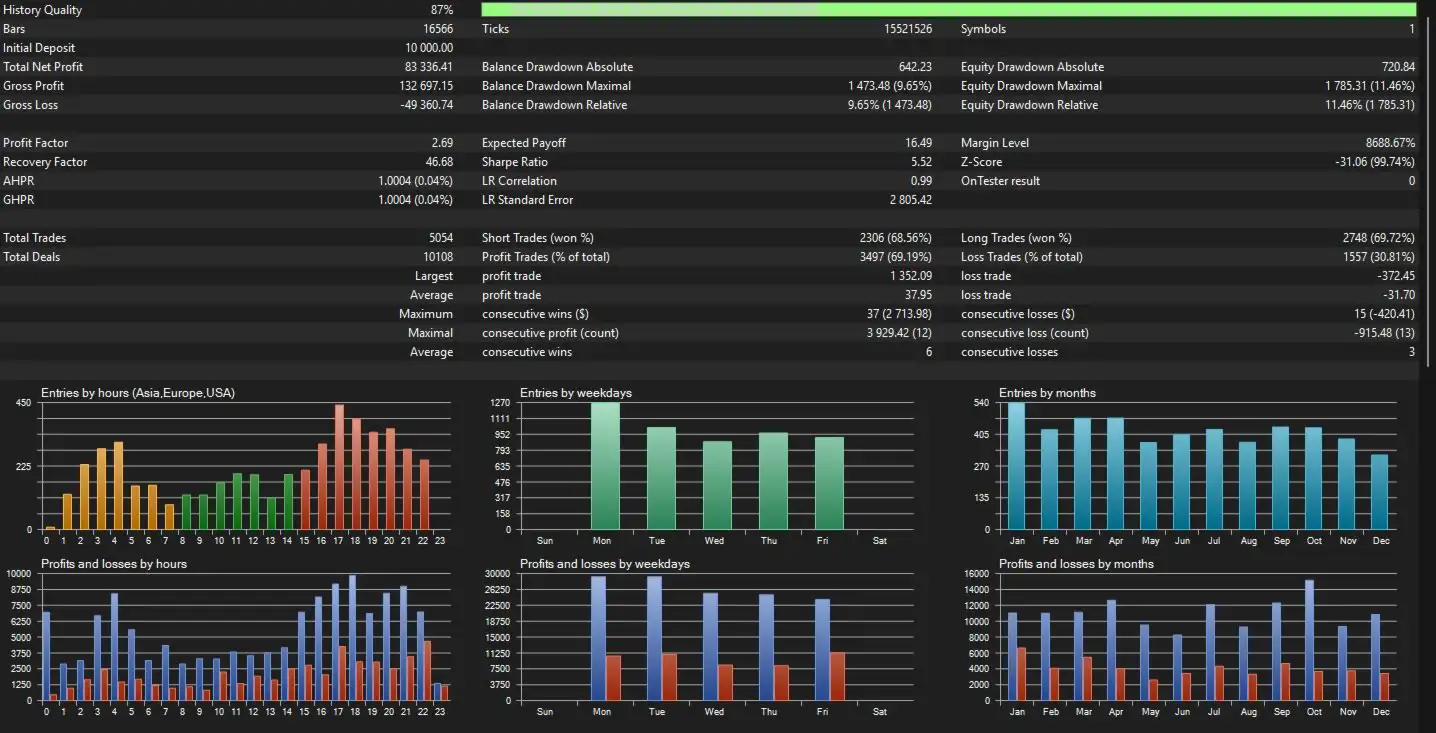
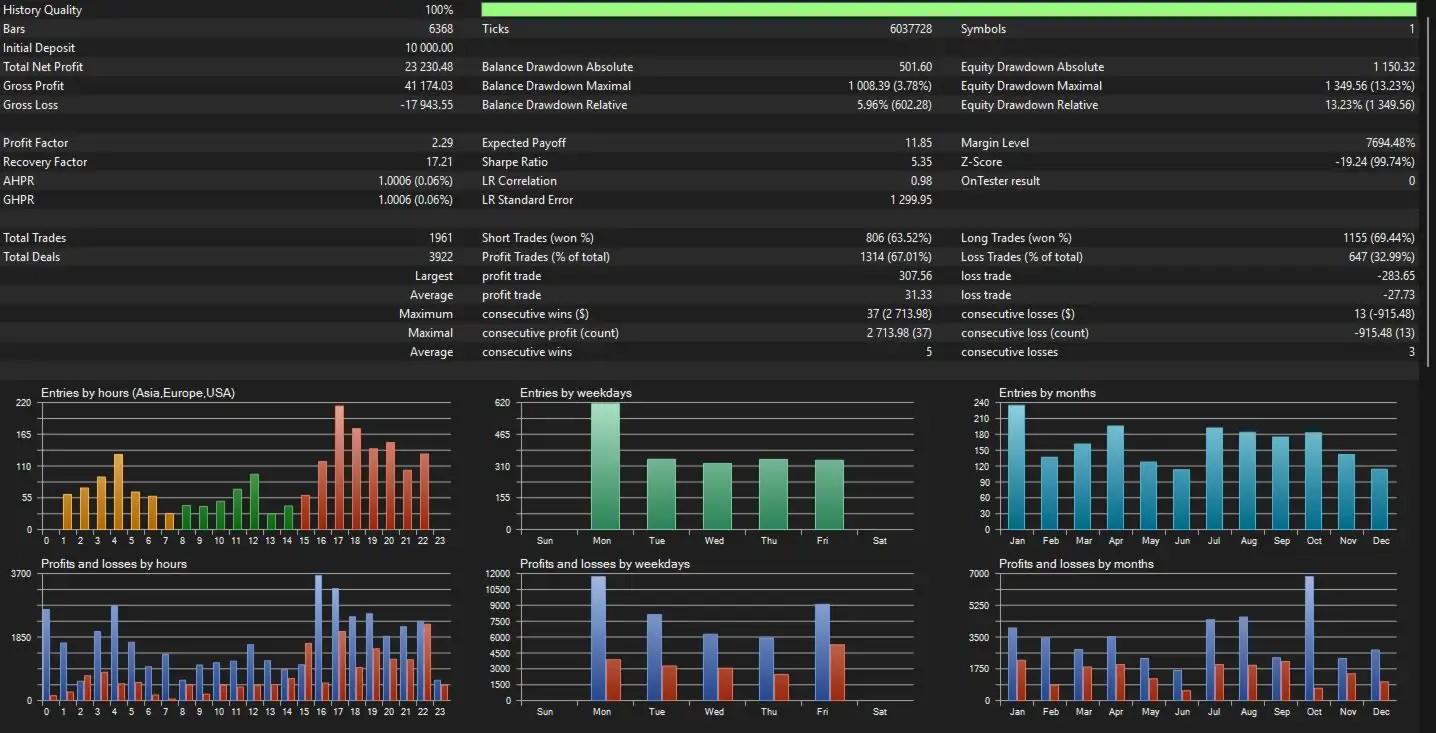
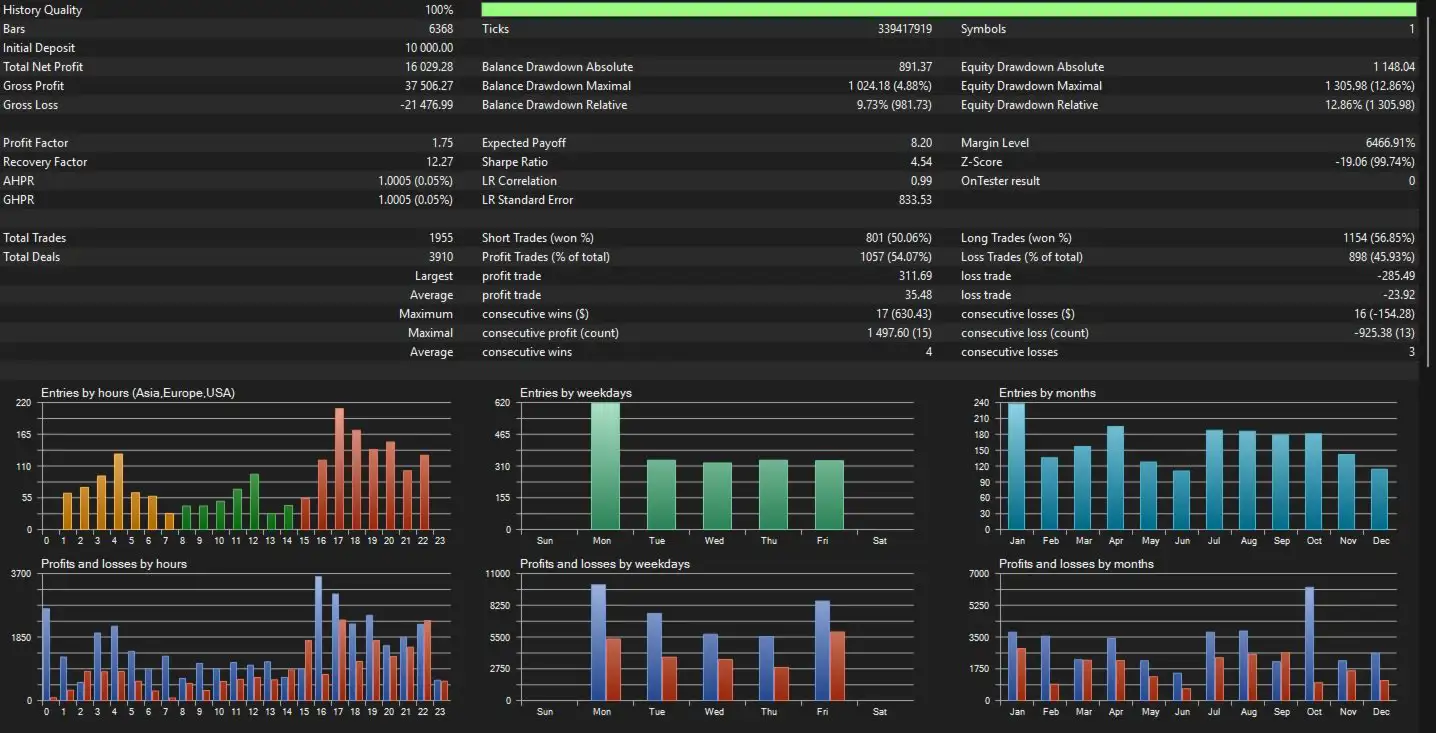
According to the supplied documentation, each candidate set file was tested using both 1M OHLC data and Real Ticks over the period from July 3, 2023, to May 30, 2026.
The reported filtering process included:
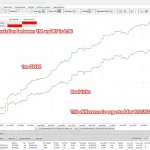
- Testing consistency: Candidates were assessed by comparing 1M OHLC and Real Ticks results.
- Real-tick performance: Strategies were removed if their Real Ticks results were worse according to the stated selection criteria.
- Out-of-sample evaluation: Candidates with unsatisfactory results in their designated out-of-sample periods were removed.
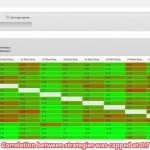
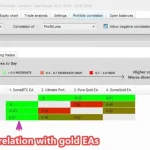
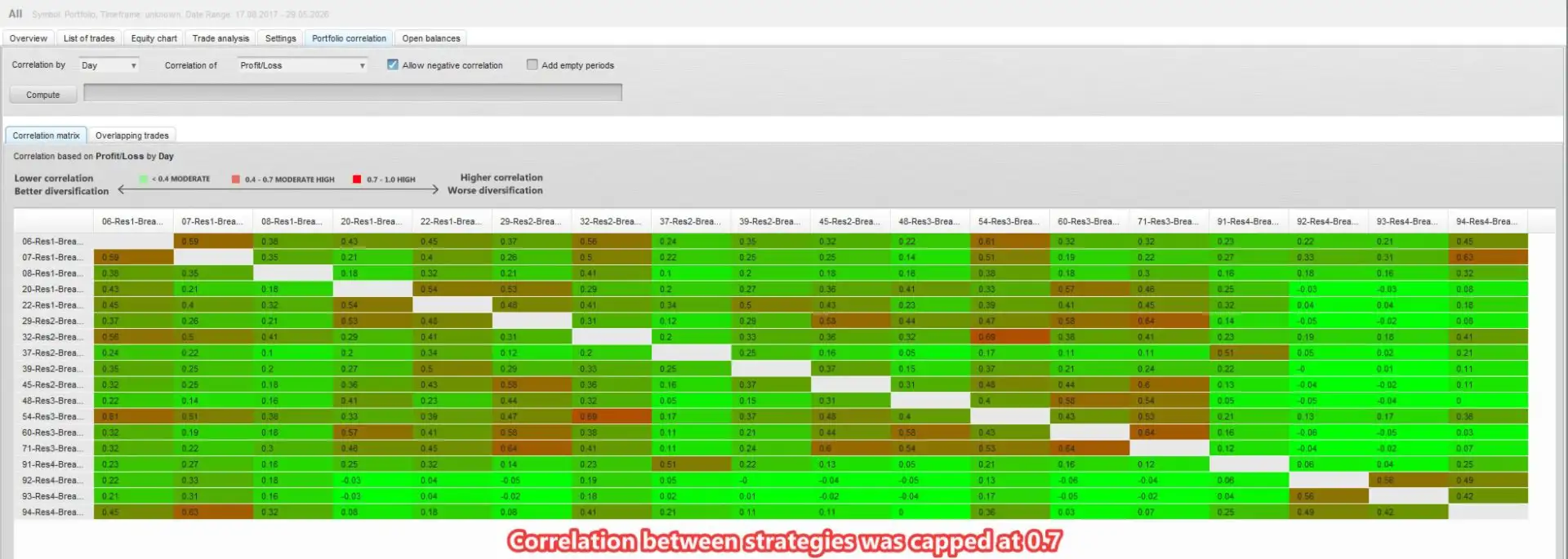
- Strategy correlation: Candidates with daily equity-curve correlation above 0.7 with another retained strategy were excluded.
These filters were intended to remove strategies that appeared less robust, performed poorly outside their optimization periods, or displayed excessive correlation with other portfolio components.
The developer reports that 18 strategies remained after filtering:
- Res1: 5 strategies retained
- Res2: 5 strategies retained
- Res3: 4 strategies retained
- Res4: 4 strategies retained
- Total: 18 strategies retained
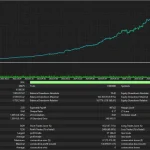
The portfolio’s selection methodology and reported results are based on the supplied product description and have not been independently verified here. Historical results can be affected by data quality, spreads, commissions, swaps, slippage, exchange or broker specifications, and test assumptions. Past performance does not guarantee future profitability.
Python-Based Portfolio Lot Allocation
According to the developer’s description, a proprietary Python script was used to calculate individual strategy lot sizes.
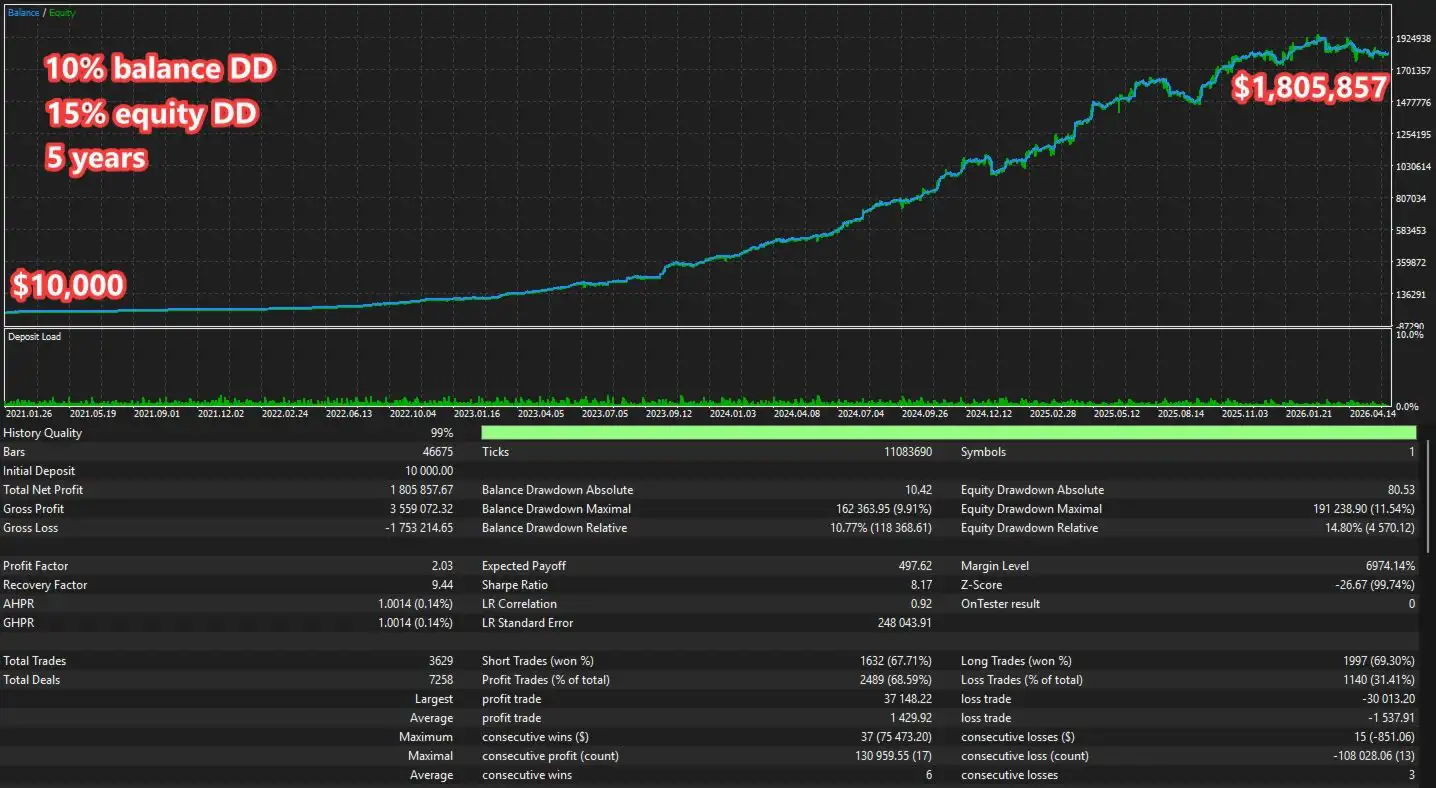
The reported objective was to maximize historical portfolio profit while keeping balance drawdown within the following specified limits:
- 1M OHLC testing: 15% balance drawdown over the 2017–2026 historical period.
- Real Ticks testing: 10% balance drawdown over the 2023–2026 period.
These figures describe the developer’s stated historical allocation criteria, not guaranteed maximum losses or enforceable live-account limits.
The product documentation also reports satisfactory results across approximately ten tested brokers. Because the underlying reports, broker configurations, and complete test conditions have not been independently verified here, traders should treat this as a developer-reported result rather than an assurance of consistent performance across brokers.
Actual results can differ due to BTCUSD pricing, execution conditions, spread changes, commissions, account leverage, and other trading costs.
SomaBTC MT5 Risk Management and Automated Lot Sizing
SomaBTC MT5 offers multiple position-sizing controls to help traders configure exposure according to account capital and portfolio settings.
Understanding these controls is important because position size directly affects both potential gains and potential losses.
Manual Lot Size and Automatic Lot-Per-Balance Sizing
Two primary sizing modes are available.
Manual lot sizing
Uses a fixed trade volume configured through StartLots. This mode provides a straightforward way to specify the lot size used by the EA.
Automatic lot-per-balance sizing
Uses LotSizeStep to calculate trade volume based on account capital and the allocation assigned to each strategy.
The AdjustLotsizeToVariableValues parameter allows lot calculations to respond to changes in balance or equity, depending on the selected sizing configuration.
LotsAdjustMinChangePercent determines the minimum percentage change required before an active lot size is updated.
The appropriate mode depends on the trader’s capital, preferred risk approach, and ability to monitor aggregate exposure from multiple strategies.
RiskMultiplier: Global Position-Size Adjustment
The RiskMultiplier parameter scales the calculated lot size globally.
Increasing the multiplier can increase market exposure and potential losses. Reducing it can lower configured trade volume, subject to minimum lot sizes and other restrictions.
The multiplier does not guarantee a specific return, drawdown, or maximum loss. Traders should assess it alongside the portfolio preset, account balance, leverage, and margin requirements.
MaxLots: Optional EA-Level Lot Cap
The MaxLots parameter establishes an optional maximum lot size for the EA when set above zero.
A value of zero means the EA does not impose its own maximum through this parameter. Broker-specific volume limits and margin requirements still apply.
Because multiple strategies can generate trades or pending orders, traders should evaluate how the lot cap interacts with concurrent positions and the portfolio’s individual allocations.
UseEquity and OnlyUp
The UseEquity parameter determines whether equity is used instead of balance as the capital reference for position sizing.
The optional OnlyUp mode allows position sizing to increase as tracked peak capital rises without automatically decreasing when account capital falls during a drawdown.
According to the supplied documentation, the EA can seed the OnlyUp peak from recent closed-trade history during startup rather than resetting the reference at every restart.
The relevant parameters are:
- OnlyUp: Allows lot sizing to increase with the tracked peak capital without automatically decreasing.
- RestorePeakFromHistory: Enables restoration of the peak reference from closed-trade history during startup.
- RestorePeakLookbackDays: Defines the number of historical days to consider; zero means all available history.
Important: OnlyUp is not a drawdown-protection feature. If account capital falls after position sizes have increased, exposure may remain comparatively high. Traders should understand this behavior before activating the setting.
ManualBalanceForLotSizing
The optional ManualBalanceForLotSizing parameter allows traders to specify a fixed capital reference when its value is greater than zero.
A fixed reference can be useful when comparing portfolio configurations or keeping sizing calculations tied to a selected capital amount.
However, the resulting exposure still depends on account currency, BTCUSD contract specifications, leverage, minimum trading volume, and concurrent positions.
Base Currency and Non-USD Accounts
SomaBTC MT5 supports the following base-currency options:
- USD
- EUR
- GBP
- HKD
- SGD
- A custom currency configuration
The BaseCurrency parameter selects the sizing currency, while CustomBaseCurrencyPair specifies the broker symbol used for conversion when a custom currency is selected.
These settings are intended to help adapt lot sizing to non-USD accounts. Actual calculations can still be affected by exchange rates, broker-specific symbol properties, and differences in contract specifications.
MarginCallProtection: Managing Potential Margin Usage
According to the supplied product documentation, MarginCallProtection is enabled by default.
Before placing additional orders, this feature treats existing same-direction pending stop and limit orders as if they may require the margin associated with market orders. This is intended to help avoid overcommitting free margin when a broker reserves little margin for pending orders.
The EA can also reduce calculated lot sizes to help keep potential concurrent same-direction orders within a margin budget linked to the selected sizing reference.
The McpRiskMultiplier parameter adjusts the risk level associated with the margin-protection lot calculation. A value of 1.0 represents the documented default multiplier.
These controls can help manage planned margin usage, but they cannot guarantee protection against margin calls, gaps, slippage, rapid Bitcoin price movements, broker margin changes, or other unexpected market conditions.
Built-In US Economic News Filter for SomaBTC MT5
Bitcoin can react to macroeconomic developments, changes in interest-rate expectations, and movements across financial markets. SomaBTC MT5 includes configurable US economic news protection for three categories of events.
- NFP: Non-Farm Payrolls
- CPI: Consumer Price Index
- IR / FOMC: Interest-rate decisions and Federal Open Market Committee events
Around eligible events, the EA can be configured to block new entries, cancel pending orders, or close open positions.
Each strategy has its own built-in protection windows measured in minutes before and after an event. This allows news settings to vary by strategy rather than applying one identical schedule across the entire portfolio.
Automatic and Manual Broker GMT Settings
SomaBTC MT5 supports manual broker GMT offsets for summer and winter, as well as automatic broker-time detection through AutoGMT.
Accurate time alignment is important because economic news filters need to correspond to the broker’s server time, including seasonal clock changes.
According to the supplied product description, the event classifier is configured to exclude common false matches, including ADP Nonfarm Employment and FOMC speeches or minutes.
For automatic GMT detection, the supplied setup instructions specify adding the following address to the allowed URLs in MetaTrader 5 under Tools → Options → Expert Advisors:
https://www.worldtimeserver.com/
Users should verify the required URL permissions and confirm that broker-time detection and event timing work correctly in their own terminal.
News filters cannot anticipate every market-moving event or eliminate the effects of unexpected announcements, price gaps, rapid movements, or execution slippage. Closing positions around economic releases can also change realized trading results.
Daily and Weekly Trading Hours for Bitcoin
Although Bitcoin trades continuously on many platforms, liquidity and trading conditions can vary significantly throughout the day and across the week. SomaBTC MT5 provides two separate time controls intended to manage when the portfolio operates.
Daily Session Filter
The daily session filter is enabled by default according to the supplied specifications.
Under the documented default behavior:
- Open trades are closed at the end of the US session.
- New trading begins after the Asian session starts.
- The EA avoids maintaining positions through the defined overnight interval.
The UseDailyTradingHours parameter controls this feature.
The associated parameters are:
- DailyStartHour: Defines the daily opening hour in broker time.
- DailyStartMinute: Defines the daily opening minute.
- DailyEndHour: Defines the daily closing hour in broker time.
- DailyEndMinute: Defines the daily closing minute.
This schedule is intended to reduce exposure during the selected lower-liquidity interval. It cannot guarantee that the chosen hours always correspond to low liquidity, and closing positions can alter realized profit or loss.
Traders can disable the daily filter if they prefer to hold positions across sessions, subject to the EA’s other settings.
Weekly Trading Window
The weekly trading window is also enabled by default, according to the supplied product description.
Its purpose is to prevent trading during the configured weekend interval, using a Friday close and Monday reopening schedule.
The main parameters are:
- UseTradingTimeZones: Enables or disables the weekly schedule.
- MondayOpenHour / MondayOpenMinute: Define when the trading window opens on Monday.
- FridayCloseHour / FridayCloseMinute: Define when the trading window closes on Friday.
- KillPending: Cancels pending orders outside the permitted window.
- KillOpen: Closes open positions outside the permitted window.
Traders can disable the weekly schedule if their broker supports weekend BTCUSD trading and they deliberately want the EA to remain active.
The default settings reflect the developer’s stated optimization approach. Users should verify their broker’s trading hours and understand the consequences of closing positions before changing the schedule.
Optional Prop Firm Compliance Features
SomaBTC MT5 includes an optional control layer intended to help manage certain restrictions that may apply to funded trading accounts. According to the supplied specifications, these controls are disabled by default.
Entry and Exit Randomization
The MaxRandomizationPips parameter can introduce a small random pip offset to trade entries and exits.
The feature is intended to create slight differences in execution levels between accounts running the same EA. Setting the value to zero disables randomization.
Randomized execution does not guarantee that a proprietary trading firm will approve the trading activity or consider it compliant with its rules.
Daily Drawdown and Order Restrictions
The EnablePropFirmCompliance parameter activates the optional compliance controls. The available settings include:
- PF_MaxDailyDrawdownPercent: Defines the maximum daily equity loss as a percentage of the daily baseline; zero disables the threshold.
- PF_MaxDailyDrawdownMoney: Defines the maximum daily equity loss in the account currency; zero disables the threshold.
- PF_DailyResetHour: Sets the broker-server hour, from 0 to 23, when the daily monitoring window resets.
- PF_DailyLossBufferPercent: Defines the buffer before the hard daily loss threshold; the documented default is 10%.
- PF_DisallowHedging: Blocks opposite-direction entries and removes opposite-side pending orders.
- PF_MaxTotalPendingOrders: Limits the total number of pending orders maintained by the EA; zero disables the cap.
The supplied documentation states that the individual controls have no performance impact when disabled. The master switch must be enabled for the associated compliance rules to take effect.
Before using SomaBTC MT5 in a funded-account evaluation, review the firm’s current requirements concerning automated trading, news trading, hedging, daily drawdown, pending orders, and execution behavior.
These settings are configurable tools, not certification of compliance or a guarantee of approval.
Live On-Chart Dashboard
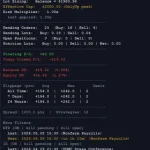
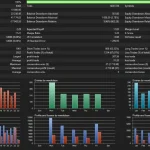
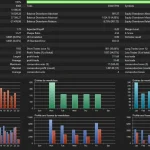
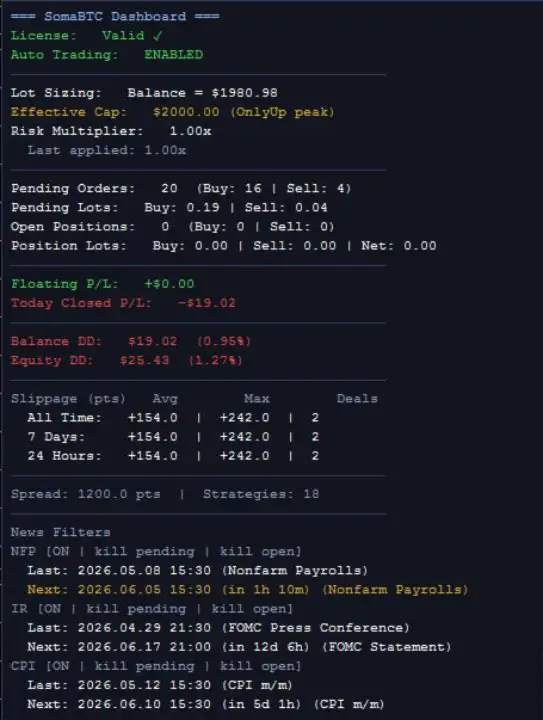
SomaBTC MT5 includes a live dashboard designed to help traders monitor portfolio activity, open exposure, account statistics, and selected market conditions from the chart.
Depending on the configuration, the dashboard displays:
- Lot-sizing reference and effective capital.
- Pending orders and open positions, separated into buy and sell sides.
- Floating profit or loss and today’s closed profit or loss.
- Balance and equity drawdown in absolute and percentage terms.
- Trading costs, including slippage, swaps, and commissions.
- Trading-cost summaries for 1-day, 7-day, 30-day, 90-day, and all-time periods.
- All-time closed profit and loss.
- Pending-order usage and broker limitations.
- Current spread and the number of active strategies.
- Upcoming and previous NFP, CPI, and IR/FOMC events.
Dashboard visibility can be configured separately for testing and live or demo charts:
- DisableDashboardInTesting: Hides the dashboard in Strategy Tester; the documented default is on.
- DisableDashboardInLive: Hides the dashboard on live or demo charts; the documented default is off.
- DashboardUpdateSeconds: Defines the dashboard refresh interval in seconds.
The dashboard is a monitoring tool rather than a substitute for broker records. Traders should review account statements and transaction history when verifying actual trading costs, fills, and performance.
SomaBTC MT5 Configuration Parameters
SomaBTC MT5 provides detailed inputs for strategy selection, trade direction, position sizing, GMT settings, news protection, trading hours, dashboard display, and funded-account controls.
Portfolio Settings
- StrategiesToRun: Selects active strategies using comma-separated, one-based strategy numbers from 1 to 18. The documented default is all 18 strategies.
The strategy numbers correspond to the #N identifier in each trade comment. For example, SomaBTC #8 72081237 identifies strategy number 8.
This parameter allows traders to isolate selected strategies for testing or exclude particular configurations. Disabled strategies stop placing and managing their associated trades, so their open positions should be closed or otherwise handled appropriately before changing the active strategy list.
Trade Identifier and Comment Overrides
- EnableMagicOverride: Enables custom trade identifiers based on OverrideMagicBase and the strategy index.
- OverrideMagicBase: Sets the starting identifier when magic-number override is enabled.
- EnableCommentOverride: Enables a shared custom trade comment.
- OverrideComment: Defines the custom comment text.
When overrides are disabled, each strategy uses its built-in identifier and comment.
Trade Direction Controls
- AllowBuyTrades: Allows long trades and buy-side pending orders.
- AllowSellTrades: Allows short trades and sell-side pending orders.
These settings allow traders to control the permitted trade direction within the portfolio.
Lot-Sizing Parameters
- Risk: Selects ManualLotSize for fixed sizing through StartLots or LotSizeStep for automatic capital-based sizing.
- StartLots: Sets the fixed lot size in manual mode or the floor reference in step mode.
- LotsAdjustMinChangePercent: Defines the minimum percentage change before the active lot size is updated.
- AdjustLotsizeToVariableValues: Allows lot calculations to respond to balance or equity changes.
- MaxLots: Sets an optional EA-level lot cap; zero means the EA does not impose its own cap through this parameter.
- UseEquity: Uses equity instead of balance as the sizing reference.
- OnlyUp: Allows sizing to increase with tracked peak capital without automatically decreasing.
- RestorePeakFromHistory: Seeds the OnlyUp peak from recent closed-trade history at startup.
- RestorePeakLookbackDays: Defines the history lookback period; zero means all available history.
- ManualBalanceForLotSizing: Sets a fixed sizing-capital reference when greater than zero.
- RiskMultiplier: Scales calculated position size globally.
- MarginCallProtection: Applies margin checks and lot adjustments for potential concurrent same-direction orders.
- McpRiskMultiplier: Adjusts the risk applied to the margin-protection lot calculation.
- BaseCurrency: Selects USD, EUR, GBP, HKD, SGD, or a custom currency configuration.
- CustomBaseCurrencyPair: Specifies the broker conversion symbol for a custom currency selection.
GMT Parameters
- Broker_GMT_OFFSET_Summer: Sets the manual broker GMT offset during summer.
- Broker_GMT_OFFSET_Winter: Sets the manual broker GMT offset during winter.
- AutoGMT: Enables automatic broker GMT detection and takes precedence over manual offsets according to the supplied specifications.
Economic News Filter Parameters
- EnableNFP_Filter: Enables NFP protection.
- NFP_CloseOpenTrades: Controls whether open positions are closed before NFP.
- NFP_ClosePendingOrders: Controls whether pending orders are canceled before NFP.
- EnableIR_Filter: Enables IR/FOMC protection.
- IR_CloseOpenTrades: Controls whether open positions are closed before IR/FOMC events.
- IR_ClosePendingOrders: Controls whether pending orders are canceled before IR/FOMC events.
- EnableCPI_Filter: Enables CPI protection.
- CPI_CloseOpenTrades: Controls whether open positions are closed before CPI.
- CPI_ClosePendingOrders: Controls whether pending orders are canceled before CPI.
Per-strategy minutes-before and minutes-after protection windows are built into the portfolio rather than exposed as separate user inputs.
Trading-Hour Parameters
- UseTradingTimeZones: Enables the weekly Monday-to-Friday trading schedule.
- KillPending: Cancels pending orders outside the permitted weekly window.
- KillOpen: Closes open positions outside the permitted weekly window.
- MondayOpenHour / MondayOpenMinute: Define the weekly opening time in broker time.
- FridayCloseHour / FridayCloseMinute: Define the weekly closing time in broker time.
Daily Session Parameters
- UseDailyTradingHours: Enables the daily session filter that closes trades at the end of the US session and resumes trading at the start of the Asian session.
- DailyStartHour / DailyStartMinute: Define the daily opening time in broker time.
- DailyEndHour / DailyEndMinute: Define the daily closing time in broker time.
Dashboard Parameters
- DisableDashboardInTesting: Controls dashboard visibility in Strategy Tester.
- DisableDashboardInLive: Controls dashboard visibility on live and demo charts.
- DashboardUpdateSeconds: Sets the dashboard refresh interval.
Prop Firm Compliance Parameters
- MaxRandomizationPips: Sets the entry/exit randomization offset; zero disables it.
- EnablePropFirmCompliance: Enables the optional compliance layer.
- PF_MaxDailyDrawdownPercent: Sets the daily equity-loss threshold as a percentage; zero disables it.
- PF_MaxDailyDrawdownMoney: Sets the daily equity-loss threshold in account currency; zero disables it.
- PF_DailyResetHour: Defines the daily monitoring reset hour in broker/server time.
- PF_DailyLossBufferPercent: Defines the buffer before the hard daily loss limit.
- PF_DisallowHedging: Applies the configured no-hedging restriction.
- PF_MaxTotalPendingOrders: Limits the number of EA pending orders; zero disables the cap.
Carefully review the interaction between these settings before running the EA, especially when changing strategy selection or modifying position-sizing behavior.
Recommended Setup for SomaBTC MT5
The following recommendations are based on the supplied product specifications and should be treated as an initial setup reference rather than a guarantee of suitability.
- Trading instrument:
- Platform: MetaTrader 5.
- Chart timeframe: Any supported timeframe, because the EA reads its internal strategy timeframes independently.
- Account type: An ECN or RAW-spread account may be worth considering where competitive spreads are available.
- Suggested minimum balance: USD 2,000 for the documented default risk configuration.
- Hosting: A VPS is recommended for stable operation throughout the broker’s supported trading schedule.
- Automatic GMT: Add https://www.worldtimeserver.com/ to the allowed URL list in MT5 under Tools → Options → Expert Advisors if required for AutoGMT.
Why the Suggested USD 2,000 Balance Matters
The supplied product documentation recommends a starting balance of USD 2,000 for the default risk configuration. This is a recommendation, not a guarantee that the account will have adequate margin or that the selected settings will be appropriate for every trader.
Actual suitability depends on minimum lot sizes, BTCUSD contract specifications, leverage, margin requirements, spreads, and the combined exposure of the 18 strategies.
Before live deployment, verify the broker’s BTCUSD trading conditions and test the EA using realistic execution costs.
Pre-Live Testing Checklist
Before using SomaBTC MT5 with real capital:
- Install the EA in MetaTrader 5 and enable the required automated-trading permissions.
- Select the correct BTCUSD instrument offered by the broker.
- Review the portfolio configuration and choose the strategies to run.
- Configure the sizing mode, capital reference, RiskMultiplier, and any MaxLots
- Examine OnlyUp behavior and the startup peak-restoration settings if enabled.
- Verify margin-protection behavior and estimate margin requirements for concurrent orders.
- Configure GMT detection and the NFP, CPI, and IR/FOMC filters.
- Review daily session and weekly trading-hour settings.
- Test the EA in Strategy Tester and on a demo account using realistic spreads, commissions, swaps, and slippage assumptions.
- Examine drawdown, execution quality, strategy correlation, and position management before committing real funds.
Testing across different market conditions can help reveal configuration weaknesses, but it cannot establish that future performance will match historical results.
Who May Benefit from SomaBTC MT5?
SomaBTC MT5 may be relevant to traders who:
- Want to explore automated Bitcoin trading on MetaTrader 5.
- Prefer a multi-strategy breakout portfolio rather than a single entry configuration.
- Want to run 18 strategies from one BTCUSD chart.
- Need flexible position sizing and portfolio risk settings.
- Value configurable protection around selected US economic events.
- Want separate daily and weekly trading-hour controls.
- Prefer a live dashboard for monitoring account drawdown, open exposure, and trading costs.
- Need optional tools for managing certain funded-account restrictions.
- Are prepared to test, monitor, and maintain an automated cryptocurrency trading system.
The EA requires a clear understanding of its configuration and potential losses. It may not be suitable for traders expecting guaranteed profits, those unfamiliar with automated trading, or those unable to tolerate substantial losses from leveraged Bitcoin price movements.
Using multiple strategies can diversify entry logic, but it does not eliminate shared BTCUSD market risk or guarantee more consistent returns.
Final Overview: Evaluating SomaBTC MT5 for Automated Bitcoin Trading
SomaBTC MT5 is a multi-strategy Bitcoin breakout Expert Advisor for MetaTrader 5, designed specifically for BTCUSD. It combines 18 selected strategies across five internal timeframes and three breakout-width variants in one chart-based trading system.
Its key features include automated and fixed lot sizing, configurable portfolio risk controls, margin call protection, US economic news filters, daily and weekly trading schedules, an on-chart dashboard, and optional prop firm compliance settings.
According to the supplied product description, the portfolio was developed from 120 optimization configurations and filtered using historical testing, out-of-sample evaluation, Real Ticks comparisons, and strategy-correlation criteria. The developer also reports using Python-based allocation to target specified historical drawdown limits.
These are developer-reported methodology details, not independently verified guarantees of performance. Traders should review the underlying test reports and evaluate the EA under their own broker’s execution conditions.
For anyone considering automated BTCUSD trading, the essential steps are to understand the strategy settings, assess combined portfolio exposure, verify margin requirements, and test the EA using realistic costs and suitable risk limits.
Historical backtests and multi-strategy diversification can support the evaluation process, but neither guarantees future profitability.
Risk Disclaimer
Trading Bitcoin and other leveraged financial instruments involves substantial risk and may result in the loss of some or all of your trading capital. BTCUSD can experience sharp price movements, rapid reversals, liquidity changes, and unexpected volatility in response to market developments and economic announcements.
Breakout strategies can generate false signals, while multiple strategies may become correlated and experience losses simultaneously. Portfolio allocations, lot-sizing controls, margin call protection, news filters, trading-hour restrictions, and optional daily drawdown controls cannot eliminate all trading risks or guarantee a maximum loss.
Market gaps, fast price changes, slippage, and broker margin adjustments may lead to outcomes that differ from historical testing. Backtested performance does not guarantee future results.
Test SomaBTC MT5 in an appropriate demo environment, understand the EA’s settings and limitations, and verify that the configuration suits your financial circumstances. Only trade with capital you can afford to lose.













Reviews
There are no reviews yet.