 English
 فارسی
فارسی






Philosopher Gold EA MT5: 22 Strategies for Automated Gold Trading
An Integrated XAUUSD Trading System for MetaTrader 5
Philosopher Gold EA MT5 is the flagship Expert Advisor in the Roman EA Series, developed specifically for the XAUUSD gold market on MetaTrader 5. It brings together 22 specialized strategy models within a single automated trading system, allowing traders to explore different market conditions through a configurable framework for trade execution, position sizing, and basket management.
Gold prices can move through trends, consolidations, breakouts, and reversals within a single trading session. Rather than relying on one entry approach, PHILOSOPHER combines multiple strategy models designed to evaluate different price behaviors and potential trading opportunities.
The system also includes broker presets, adjustable sizing profiles, USD economic news filtering, drawdown controls, and The Agora dashboard, which displays strategy activity and account information.
An important feature of PHILOSOPHER is its use of basket-based grid recovery with progressive position sizing. Traders should understand how this mechanism works, including its potential to increase exposure and drawdown, before using the EA on a live account.
22 Specialized Strategies for Different Gold Market Conditions
The PHILOSOPHER EA incorporates 22 strategy models intended to assess different characteristics of the gold market. Each model evaluates its own entry conditions and applicable filters, providing a range of systematic approaches within one Expert Advisor.
The available strategy concepts cover several areas of technical analysis.
1. Trend Continuation and Momentum
Trend-following models aim to identify conditions in which an existing market direction may continue. Momentum-based approaches evaluate price movement to help determine whether a potential entry aligns with the prevailing move.
These models are designed to address directional market conditions rather than relying exclusively on reversal signals.
2. Pullbacks and Retracement Entries
Pullback strategies focus on temporary price movements against an established direction. Some selected PHILOSOPHER models can refine an eligible signal by waiting for a retracement and subsequent reclaim or continuation confirmation before entering a trade.
This additional confirmation step is intended to make entry conditions more selective, although it cannot eliminate false signals or trading losses.
3. Breakouts and Volatility Expansion
Breakout models evaluate price movements beyond relevant trading ranges or other reference levels. They are designed to identify potential opportunities when the market moves out of consolidation and volatility expands.
Breakouts can fail or reverse quickly, particularly during unstable market conditions, so appropriate risk management remains important.
4. Session Ranges, Sweeps, and Reclaim Patterns
Some strategy models examine session-related price ranges, movements beyond reference levels, and subsequent price recoveries. These patterns can help define possible entry conditions around intraday market structure.
Their effectiveness depends on the market environment, the selected strategy, and the quality of the underlying price feed.
5. Tick-Weighted VWAP References
PHILOSOPHER also uses relationships between price and tick-volume-weighted VWAP references in relevant calculations. These references provide another way to evaluate price relative to an activity-weighted benchmark.
They should be interpreted as technical inputs rather than direct evidence of market-wide trading volume or institutional positioning.
6. Relative Tick-Volume Activity
Selected calculations consider relative tick-volume activity to assess changes in the level of activity reported by the broker’s feed.
This information can contribute to strategy conditions, but tick volume is not equivalent to the total amount of gold traded across the global market.
Automated Entry Selection and Basket Management
PHILOSOPHER combines strategy-specific entry logic with a shared basket-management framework. When a strategy opens a trade, the basket engine manages subsequent positions and evaluates exit conditions according to the system’s rules.
This structure allows entry selection and position management to operate as parts of one integrated Expert Advisor.
ATR-Based Recovery Spacing
The EA uses Average True Range (ATR) to account for market volatility when determining recovery spacing. ATR is a technical indicator that measures the magnitude of recent price movement.
Using volatility-sensitive spacing can help the recovery mechanism respond to changing market conditions. However, it does not prevent adverse price movements or guarantee that a basket will recover.
Progressive Position Sizing
PHILOSOPHER uses a 1.5-times position-sizing progression for recovery trades, subject to applicable sizing caps and the broker’s permitted lot increments.
Progressive sizing can increase the weight of later positions within a basket. If the market continues moving against the basket, this approach may increase floating losses, margin requirements, and total account exposure.
Traders should review the progression and its implications before choosing their trading settings.
Basket-Based Exit Logic
Instead of requiring every individual position to close with a profit, PHILOSOPHER evaluates exits based on the combined basket.
This approach considers the overall position rather than treating each order as an independent trade. Basket-level exits do not guarantee a profitable result, and a basket may close at a loss depending on its configuration and market conditions.
Main-Basket Position Limit
The current main-basket limit is five positions, including the initial entry. This limit applies to an individual directional strategy basket, not to the entire trading account.
Conditional recovery hedges may create additional exposure beyond the main-basket position count. On hedging accounts, enabling multiple strategies can also allow separate strategies to maintain their own baskets in the same direction.
As a result, total account exposure may be greater than the main-basket limit suggests.
Flexible Settings for Different Trading Requirements
PHILOSOPHER offers several configuration options to help traders adapt the EA to their preferred exposure level, broker environment, and risk-management requirements.
Five Position-Sizing Profiles
The available sizing profiles are:
- Very Low
- Low
- Balanced
- Medium
- High
Fixed-lot and custom balance-scaling alternatives are also available.
These profiles represent relative exposure settings rather than guaranteed risk limits. The actual risk depends on position sizes, basket behavior, market conditions, account equity, and other configuration parameters.
Broker Presets
PHILOSOPHER includes presets for several broker environments:
- TMGM
- ICM
- Vantage / VT / Ultima
- RoboForex
- Other
- Custom
Choosing an appropriate preset is part of preparing the EA for use. Traders should verify symbol naming, contract specifications, spreads, lot increments, and execution conditions with their own broker.
A preset does not guarantee identical execution or performance across different accounts.
Drawdown Protection
The EA provides configurable overall drawdown protection and optional daily protection. Depending on the selected configuration, protective actions can include closing positions and continuing or closing positions and stopping further trading.
These controls are intended to help users define how the system responds to specified risk conditions. They should not be interpreted as guarantees of a maximum realized loss because slippage, gaps, execution delays, and other factors can affect actual results.
Execution Filters and Trading Restrictions
PHILOSOPHER includes several checks that can influence whether trades are permitted, including:
- Entry-spread limits
- Margin checks
- Trading-session restrictions
- Strategy-specific entry conditions
These checks help define the circumstances under which the EA can initiate or manage trading activity.
USD Economic News Filter
The EA includes a configurable filter for selected USD economic events. Users can choose event coverage and adjust the pause windows before and after news releases.
Economic announcements can cause sharp movements in gold prices, wider spreads, and unstable execution. A news filter may restrict selected trading activity around scheduled events, but it cannot eliminate all news-related risk or account for every unexpected market development.
The Agora Dashboard: Monitor Your Trading Activity
The Agora dashboard provides a centralized view of important strategy and account information, helping users follow the EA’s activity while it manages trades.
Depending on the displayed information, users can monitor:
- Enabled strategies
- Open positions
- Lot sizes and position exposure
- Floating profit or loss
- Account equity
- Margin information
- Drawdown
- News-related entry pauses
- Grid-addition status
- New hedge status
This visibility helps traders understand the system’s activity from the initial entry through basket management and exit decisions.
Monitoring tools can improve transparency, but they do not replace independent risk assessment or guarantee that protective actions will execute exactly as intended.
Understanding Tick-Volume Analysis in PHILOSOPHER
PHILOSOPHER uses broker tick-volume activity in selected calculations, including certain price references weighted by tick volume.
Tick volume generally reflects the number of price changes or ticks recorded by a particular broker’s feed during a period. It is not a direct measurement of all gold transactions conducted across the market.
This distinction matters when interpreting trading signals. Tick-volume readings can differ between brokers, and these differences may influence calculated references and strategy conditions.
Tick-volume analysis should therefore be treated as one technical input within the system, not as proof of institutional buying, institutional selling, or market-wide order absorption.
Who Is Philosopher Gold EA MT5 Designed For?
Philosopher Gold EA MT5 may be relevant to traders who:
- Want to explore systematic XAUUSD trading on MetaTrader 5.
- Prefer multiple strategy models within a single Expert Advisor.
- Are interested in trend, momentum, breakout, and pullback approaches.
- Want configurable position sizing and basket-management options.
- Need broker presets and adjustable execution filters.
- Value dashboard-based monitoring of account and strategy activity.
- Understand the mechanics and risks of grid recovery and progressive position sizing.
PHILOSOPHER is not a risk-free trading solution. Its suitability depends on the user’s experience, trading objectives, financial circumstances, and tolerance for drawdown.
How to Prepare Philosopher Gold EA MT5 for Trading
Before using the EA on a live account, take time to understand its configuration and test its behavior.
Step 1: Confirm broker compatibility. Check that your broker supports XAUUSD or the relevant gold symbol and verify the contract specifications.
Step 2: Select the appropriate broker preset. Choose the available preset that matches your broker or configure the relevant parameters manually where necessary.
Step 3: Choose a sizing profile. Review the available exposure settings and consider how progressive recovery sizing may affect the account.
Step 4: Configure risk controls. Examine the overall and daily drawdown protection settings, spread limits, margin checks, and other restrictions.
Step 5: Review the news filter. Select the relevant USD event coverage and set the desired pause windows around scheduled releases.
Step 6: Test in the MT5 Strategy Tester. Evaluate different market conditions and pay particular attention to basket growth, recovery behavior, floating drawdown, margin usage, and exit logic.
Step 7: Monitor performance carefully. If you proceed beyond testing, review the EA’s activity regularly and ensure that your exposure remains consistent with your risk tolerance.
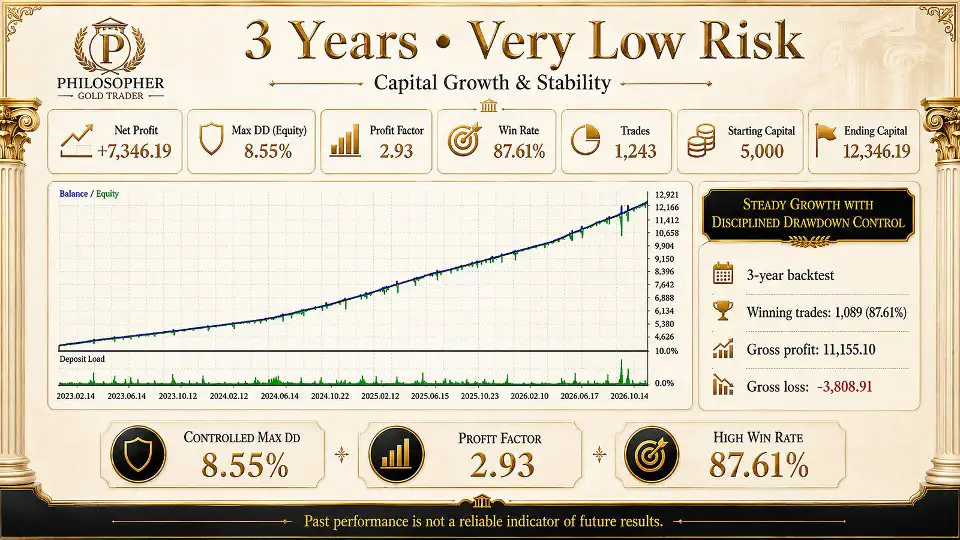
Backtests and demo results can help identify potential issues, but neither can guarantee future live trading outcomes.
Key Considerations Before Using a Grid Recovery EA
Grid recovery systems can behave differently from strategies that use only a single position per trading signal. When the market moves against an existing basket, additional positions may be opened according to the configured recovery rules.
With progressive position sizing, later trades can contribute more exposure than earlier ones. Prolonged adverse movement may therefore lead to substantial floating drawdown, greater margin usage, or forced liquidation if available margin becomes insufficient.
Other factors, such as spread widening, slippage, market gaps, connectivity problems, and multiple strategies trading the same instrument, can further affect account risk.
For these reasons, traders should evaluate not only potential returns but also worst-case exposure scenarios, recovery behavior, and the possibility of significant losses.
Final Thoughts on Philosopher Gold EA MT5
Philosopher Gold EA MT5 brings 22 specialized strategy models into a single automated XAUUSD trading system for MetaTrader 5. Its features include trend and breakout analysis, pullback confirmation, ATR-based recovery spacing, progressive position sizing, configurable risk controls, broker presets, USD news filtering, and The Agora dashboard.
The system is designed to give traders multiple approaches to gold trading within one configurable framework. At the same time, its basket-based grid recovery mechanism makes it essential to understand position growth, cumulative exposure, and drawdown before deployment.
For traders considering a Gold Expert Advisor for MT5, a careful evaluation of the strategy logic, broker compatibility, risk settings, and historical testing results is an important part of the decision-making process.
Risk Disclaimer: Gold trading involves substantial financial risk. Grid recovery and progressive position sizing can increase exposure when prices move against an open basket, potentially resulting in significant drawdown, margin pressure, and the loss of some or all trading capital. Multiple strategies may remain exposed to the same underlying gold market. Position limits, hedges, news filters, and drawdown controls do not guarantee recovery or cap realized losses. Execution conditions, market gaps, and connectivity issues can affect their operation. Backtests, historical results, and monitoring records do not guarantee future performance. Only trade with capital you can afford to lose and choose settings consistent with your financial circumstances and tolerance for risk.












Reviews
There are no reviews yet.